Eschatological Being

Eschatological Being
Vertical Particularity meets Horizontal Universalities

Thursday, June 4, 2015

Goryoginja Shrine Kamakura


Goryo Shrine is dedicated to Kamakura Gongoro Kagemasa, a warrior who distinguished himself in a battle in the late Heian period. He known as “Gongoro-sama” by the locals. A famous annual event called “Menkake Gyoretsu” is held on September 18. The masks are stored in the treasure house of the shrine.
Goryo is an honorific term used to repsectfully refer to departed ancestors souls. This Goryo Jinja Shrine was built towards the end of the Heian period to honor Kamakura Gongoro Kagemasa, descendant of Kammu Tenno and leader of the Kamakura samurai army.
Kagemasa became renowned for his bravery during the Gosannen War (1083~1087), in which he fought at 16 years old. He went on to become a feudal lord and develop Shonan region. located in present-day kamakura. He was loved by the people of his region, who gave him the name “Gongoro-sama.”
The Menkake Precession is held in September every year. It features a highly original ritual where masked people walk through the streets wearing traditional masks such as Gigaku, Bugaku, and Dengaku.
(photos mine.  notes from:  http://aboutkamakura.com/venue/goryo-jinja-shrine/)

Can't wait to see this festival later this year.

The shrine is located next to the enoden line and many people come to take a scenic picture of the train amidst the ajisai.   Alas, I am no professional, but I still had fun trying.


Hasedera Temple Kamakura


Ajisai  and Spirits


After Meigetsuin in Kita-Kamakura, Hasedera is the in place for Ajisai viewing.  They even post a huge board with Disney like notices letting you know how long a wait to see the flowers  based on your number; the wait times on the board often exceed two hours.   But I arrived just ahead of peak season time and first thing in the morning and while I did not have the place to myself, it was relatively peaceful and quiet.   Perfect for a stroll amidst the lovely blooms and the playful spirits and gods of Hasedera.

Hasedera is located off the Enoden railway line on a hillside, allowing for wonderful views to the sea. While the temple which now belongs to the independent Jodo sect is not that old, it does house a beautiful kannon statue with reputed historical significance.   Other temple statues are very beautiful as well and worth the trip.   


Wednesday, May 27, 2015

Hokokuji Temple Kamakura


The Bamboo Temple

Established in 1334, Tengan Eko was founding priest of this Rinzai Zen Buddhist Temple.  Better known by his Budhhist name, Butsujo Zenji, was a part of the Five Mountains Zen Literary Movement and many of his writings are National Treasures.

Hokokuji was the Ashikaga and then Uesugi Family Temple with many Yagura (burial caves) of famous family members.

There are many gorinto (five tiered memorials - see picture below) that were dedicated to the warriors involved in the 1333 Kamakura battles that saw the end of the Kamakura shogunate and the eventual rise of the Ashikaga shogunate.


Monday, August 20, 2012

Florida Morning Run

In the mornings I head out for a run.   It is still dark out and as I make my way I have to give all my attention to that which is just ahead of me so that I don’t trip on an unseen hazard or get hit by someone driving who is already at work in their minds and not paying attention to what is around them.  I try to lessen the load of my run by escaping it with my thoughts, but my body screams as it is so rudely awakened by my intentional use of already sore muscles and aging joints, and it won’t let me.


As I turn the corner onto Beach Blvd. I get a glimpse of the goal of my run.  Just a mile ahead is the intercoastal bridge, my old nemesis.   Each morning it both challenges me with its grade and it beckons me with the suns rays that begin to color the sky.  I have timed it just right with the sunrise.   I keep going and my gait picks up in anticipation of the promise of making the summit of the bridge.  As I climb the bridge I know that just a mile and a half away (we runners always know our distances from landmark to landmark) the sun has breached with intensity and almost violence the morning horizon of the Atlantic Ocean.   Light meets dark with an explosion of energy and promise.  But my view of this grand event is blocked even at the top of the bridge.   So as I pause to catch my breath and rest my already weary body, my gaze turns to the intercoastal waters.  Here the suns rays color the waters gently.  There are not sharp lines, just soft washes of rose, lavender and yellow.  
The usually busy intercoastal filled with fisherman, sailors and motor boats towing children on waveriders are absent this time of day.  The water is flat and calm.  The boats in the adjoining marina wait expectantly for their captains to arrive.   At that moment, I don’t hear the cars dash by me, hurrying their drivers on to the busyness of the day.   I am alone with the occasional dragonfly and the crane below searching for its morning breakfast.   In this brief respite, I am stilled and content. 
I don’t stay long.  Even just a minute as part of this magnificent landscape is enough to carry me through the day.  I turn westward, and re-start my run.  The colors on the water instantly vanish and the water turns brown again, a blank canvas waiting for the artist to color it anew the next morning.  Meanwhile the colors have settled into my mind and my imagination wanders to the promises ahead of me, now softly colored in rose, lavender and yellow.


Friday, October 8, 2010


Benedict Wrote:

"Listen, listen.  It will break your heart, but it will also give you a heart.  And it will give you more, it will give you life.  Only Love is strong enough to hold all the pain in the world.  Love will listen.  If you aren’t listening, you aren’t loving.”

I read a story once about a boy named Paul who was just eleven when his father took him to meet his great-aunt Margaret in the nursing home, where she had been moved because of dementia.  During the visit, Aunt Margaret told Paul and his father stories that were 85 years old.  Stories that happened almost a century ago.  As she talked and talked, the father became concerned that the boy would grow restless and would not be polite hearing the countless…When I was a girl.

So he cut the visit short.  Going out to the car, the father tried to explain to his son about dementia, but the son, told the father to stop making excuses, Aunt Margaret was just remembering who she was.

During the season’s of the Christian year, with their regular patterns, we are remembering whose we are.  And we frame these stories through the telling of Christ’s story and our story in his.  And as we listen to each other, as we come together to share meals, we are listening and remembering who we are and whose we are. 


Listening then, is a Christian act, of helping others remember who they are.  

Tuesday, June 8, 2010


Fyodor Dostoevsky, on the eve of modernity’s pinnacle, lamented that Russians had “seized hold of civilization and at once, blindly and devotedly, adopted the creed that it was precisely in civilization that we could find the ‘universality’ destined to unite humanity.”[1]  He was speaking of modernity’s creed, embedded in the rationalism of science and math that had taken Europe and America by storm and was quickly spreading east to Russia.  Dostoevsky, the prophet, realized the fallacy inherent in the modern creed of progress that created a Euclidean problem of asserting universal scientific reality over and against spiritual particularity.  This artificial separation of the natural and the unnatural, duped humans into believing that a public universal ideal could be achieved here on earth, separate from the private (as modernists claimed) values of God. 
As science encountered the intricacies of the created order, not to mention human existence, categories and specialties were generated to explain and rationalize the chaotic.  Libraries flourished in modern times as more and more paper was used to document, categorize and enlighten our existence on earth.  Burgeoning universities demoted Christianity and religious study to an optional curriculum that dealt with a private sphere of values.  Philosophy became more ‘scientific’ with the introduction of psychology.  Recently rationalists created Cultural Studies theory, as another specialty to help interpret and categorize data of human existence.   While much of Cultural Studies operates on a rational Euclidean plane, it contains within it, a potential to critique the claims of its source, modern rationalism.  This critique provides the possibility for collaboration between Cultural Studies and Christianity that breaks down modernity’s Euclidean structures and re-introduces a cosmic multidimensional view of God’s created order.
...

Christianity asserts another dimension into the particular/universal human reality.  Christianity breaks down the Euclidean fallacy and replaces it with a multidimensional view of history.  Particulars are events that cannot always be neatly fashioned into the horizontal universal sweep of history.  The event, in fact, may be vertically aligned to the point that it resists horizontal integration.  In this case, the particularity may only fit into a vertical universality.  When this happens, pre-modern cultures say a miracle happens; modernists on the other hand often will adjust their universal constructs to explain away the unnatural as just another natural event.  In most cases, however, particularities can be best integrated into a universal when that universality is understood in both vertical and horizontal terms.  Cultural Studies oriented toward the horizontal, needs a vertical universal in order to avoid the modern trap of hegemony. 
Christianity, with its foundation in the incarnation and its orientation towards the eschatological, supplies the universal vertical dimension needed to counter rational modernity’s hegemony.  The incarnation of Jesus Christ is the particular revelation of Jesus Christ within historical time of God’s universal purposes.  The universal is not presented as abstract ideas or values, but in the particular life of Jesus Christ.  The vertical orientation is always grounded in the particular as it looks upward towards the universal.  “Jesus’ meaning is contained in the telos built into his biography; his life is lived toward resurrection, back toward his extra human, supra-individualistic state.”[2]
The eschatological vertical dimension embraces the fluidity of particular contracts because of the yet, but not yet aspect of human history, while still holding to the telos of God’s universal purposes.  This eschatological promise reveals that any universal interpretations and classifications are only temporary, and at best only partially reveal actualities contained in particular contracts.  As such universalities that are not fluid themselves are ideologies that seek to replace the ultimate truth revealed in God.  Even religious universalities such as doctrines and creeds are particularities that have been improperly universalized.  They have been created by a structure and are meant to reify particularities and maintain boundaries between the structure’s insider faithful and the outsider heretics.  Does this mean that all Christianity then is relative?  On the contrary, the universal is the particular fact of Jesus Christ that reveals vertically the universal purposes of God.  This vertical revelation replaces any horizontal universality.  
...
Chakrabarty identifies modern Europecentrism as a dominant force that shapes historical discourse and Cultural Studies.  I would add that it does so through its assertion of factual cause and effect, which elevates the written word over oral communication.  The written word reifies individual and group contracts through its ability to chronicle events into a historical whole.  When this is done, the particular event becomes universalized into factual history.  Written history has been in place well before modern times, but the peculiar ‘contribution’ of modernity is the belief that all events and contracts are natural and “everything can be historicized.  So while the nonnaturalness of history, the discipline is granted, the assumed universal applicability of its method entails a further assumption: that it is always possible to assign, people, places, and objects to a naturally existing, continuous flow of historical time.”[3]   The logical conclusion is that particular events and contracts narrate themselves into a universal history; therefore they are not in need of a universalizing telos.
Within modernity’s written history, particular attempts to re-narrate events or to shift history are judged against a norm that is assumed to be inherent in the event itself.  This modern understanding ignores political power differentials and other variables such as group membership requirements and status, levels of mobility, valuations of communication types, typologies and level of enforcement.  The historian is the person responsible for laying out the facts into their natural and prescriptive universal whole.   Attempts to rewrite history by the marginalized often generate Euclidean claims.  In other words, histories run side by side concurrently.  For example in the Greensboro Truth and Reconciliation Commission process, there are two histories, one for the predominately black participants and one for the culturally dominant white surrounding community.  The Commission attempts to bring the black history into the white history; the problem is, however, that white history has already narrated and reified the events in written form; therefore within a modern construct of history, any black rewriting of the event will continue to run parallel to the white history, as an undercurrent representative of an alternative view.
Christianity, which comes to us in written form, is particularly susceptible to modern Euclidean history.  The Christ event, as recorded in the New Testament is an event that can be reified into a modern historical fact separated from its divine telos; modernity separates the incarnation from its divine source and purpose into a Gnostic parallelism of natural human Jesus and unnatural divine Christ.  The natural human Jesus becomes the possession of humanity under modernity as a material process to protect, interpret and control.   The incarnation of Jesus Christ is intended less to inspire eschatological imagination and is destined to be a controlled cultural artifact used in the production of meaning.  This meaning runs within human history while the divine Christ runs in the modern parallel Euclidean dimension just above human history. (See figure 1).  Its parallelism prevents the divine Christ from ever intersecting and disturbing human history. 
The Euclidean dilemma of modernity is broken through in the apocalyptic vision of God’s in-breaking eschatological Kingdom as witnessed in the particular life incarnation of Jesus Christ.  Is the incarnation, death and resurrection of Jesus Christ a fact?  Yes, but it is a fact that is both natural and unnatural, human and divine.  It is the vertical and horizontal intersection of God’s purposes with human history.  At this intersection, the two dimensional plane is exploded into an endless multi-dimensional possibilities.  (See figure 2).
“…Paul Minear makes the point that John’s cosmology in the book of Revelation is not dominated by the (Euclidean) categories of time and space but rather by heaven and earth, with primacy accorded to the heavenly realm.  Furthermore, there is not merely a ‘first’ heaven and earth (ta prota, 21:4, which ultimately passes away), but also a ‘new’ heaven and earth, which constitute the decisive frontier of the old – not in terms of temporal succession (though the new heaven and earth do not pass away) but as an alternative cosmic order and community in which God dwells and is worshipped as Sovereign.[4] 

How then does this new understanding of Christianity shape the prophetic role of Cultural Studies within this new understanding of Christian theology?  It is one that is clearly apophatic, rather than universalizing.  Its purpose is to expose and rid narratives that are universalizing and hegemonic.  It is not to interpret or reify, but to point to intersections where the vertical universal purposes of God intersect with the horizontal particularities of human reality.  When this happens, the Euclidean planes that separate narratives merge, not into a modern rational universal, but into a narrative that provides a telos that breaks any human attempt to claim universal meaning and purpose.  It is a telos that is particularly witnessed from a slave’s point of view. 
“…the slave’s perspective require a discreet view not just of the dynamics of power and domination in plantation societies dedicated to the pursuit of commercial profit but of such central categories of the Enlightenment project as the idea of universality, the fixity of meaning, the coherence of subject, and, of course, the foundational ethnocentrism in which these have all tended to be anchored.”[5]

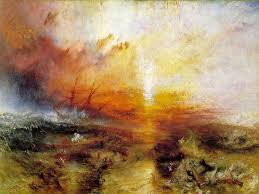
 "The Slave Ship" by J M W
Christian apocalypticism exposes the lies of modernity and the chaos it has created, as represented in Turner’s “Slave Ship.”  In the midst of the chaos of death and despair, there is a vertical ray of light that represents God’s eschatological light that illuminates the evil of modernity, stripping it of its power and revealing the true telos of all created beings.  Far from creating meaning through material processes that reify particular contracts into archaic cultural artifacts, Christianity transcends modernity and celebrates where the horizontal particular meets the vertical universal of God. 
In this multidimensionality, the prophetic purpose of Theological Cultural Studies is to follow Chakrabarty’s lead and begin to challenge modern assumptions and universalizing narratives without specifically knowing what the new narrative will look like.  The task is particularly at this moment a prophetic call to repentance.  Modernity has been a force that particularly lined up well with Christianity.  It will take a lot of deconstruction to untangle their closely-knit narrative ties.  Once deconstruction is completed, I cannot predict whether Theological Cultural Studies will survive, after all it is a modern construct itself.  Perhaps culture, and the individual will remain distinctive, but with new ways of relating to each other; perhaps they will disappear.  Whatever the future holds, God’s narrative of what it is to creatively live into God’s eschatological and multidimensional historical intersection has always been in conflict with earthly narratives; therefore, God has always been in need of particular prophets to remind creation of its universal telos.   


[4] P. Travis Kroeker and Bruce K. Ward, Remembering the End: Dostoevsky as Prophet to Modernity (USA: Westview Press, 2001), 100.
 [5] Paul Gilroy, The Black Atlantic (Cambridge, MA: Harvard University Press, 1993), 55.
[3] Dipesh Chakrabarty, “The Time of History and the Times of Gods” Lisa Lowe, ed. The Politics of Culture in the Shadow of Capital (Durham: Duke University Press: 1997), 36.
[2] Michael Holquist, Dostoevsky & the Novel (Evanston, IL: Northwestern University Press, 1977), 111.
[1] Fyodor Dostoevsky, A Writer’s DiaryVol.2, Translated and Annotated by Kenneth Lantz (Evanston, IL: Northwestern University Press, 1994), 831
Photo Credits: 
JMW Turner Slave Ship:   https://en.wikipedia.org/wiki/The_Slave_Ship

Sunday, May 24, 2009

Stories Beyond Ouselves

Each year on Memorial Day, Americans remember those who died serving their country. Once known as Decoration Day, Memorial Day is a tradition where we remember those who died serving their country. In the original general order establishing Memorial Day the purpose of such an observance was twofold. First, the observance was meant to preserve the Spirit in which the men and women served their country with courage and honor.
The second purpose as described in the original order of 1868 was, and I quote:
“Let us, then, at the time appointed, gather around their sacred remains, and garland the passionless mounds above them with choicest flowers of springtime; let us raise above them the dear old flag they saved; let us in this solemn presence renew our pledge to aid and assist those whom they have left among us a sacred charge upon the Nation's gratitude—the soldier's and sailor's widow and orphan.”
The observance was meant to remind us that we have a responsibility. The men and women who fought and died for our country, did so for our freedom. But not for a freedom to do just anything we want. No they fought so that we could have the freedom to continue to be a part of a story that was bigger than us. A story of courage, of bravery, of dignity, righteousness and selflessness. A story of responsibility to take care of others less fortunate than us.
A story that I believe is deeply rooted in our understanding of God.
Psalm 24 speaks of such a story:
Psalm 24:1 - 25:1 RS Psalm 24:1 The earth is the LORD's and all that is in it, the world, and those who live in it; 2 for he has founded it on the seas, and established it on the rivers. 3 Who shall ascend the hill of the LORD? And who shall stand in his holy place? 4 Those who have clean hands and pure hearts, who do not lift up their souls to what is false, and do not swear deceitfully. 5 They will receive blessing from the LORD, and vindication from the God of their salvation. 6 Such is the company of those who seek him, who seek the face of the God of Jacob.1 Selah 7 Lift up your heads, O gates! and be lifted up, O ancient doors! that the King of glory may come in. 8 Who is the King of glory? The LORD, strong and mighty, the LORD, mighty in battle. 9 Lift up your heads, O gates! and be lifted up, O ancient doors! that the King of glory may come in. 10 Who is this King of glory? The LORD of hosts, he is the King of glory. Selah

The psalmist begins with the profound declaration that the earth is the Lord.
In Hebrew the order is slightly different, “To Yahweh belongs the earth,” its inhabitants, its fullness. It is all God’s property and possession. God in his generosity has created the earth, had created us. And in his sovereignty God has ordered the world and in return God asks only that we live our lives in gratitude to Him.
But what does such a life look like?
Well the first point is for us to realize that we are not the ultimate authors of our stories. God, as King is.
§ He not only created us,
§ but he desires to write our story,
§ to order our lives.
But here is the rub. We often don’t want God to write our stories. We want to take control and write our own.
And God gives us the freedom to choose which story we want to write.
He gives us the material of our lives, and then he lets us decide how we want to write the story of our lives.
And many, Christian and non-Christian, choose to go it without God. And I believe that their stories are nothing but fiction with a lot of:
§ passion,
§ a lot of greed,
§ hate,
§ jealousy,
§ envy
§ and lust.
You know what kind of fiction I am talking about. Dime store novels,
§ with a lot of action
§ but no real plot and one dimensional characters.
§ That is a life lived in the freedom without God.
John Wesley, in his sermon entitled Advice to Soldiers, wrote that living in Hades is doing what we want. What may look like freedom is in actuality enslavement to our own passions and desires.
In such stories, there is a lot of brokenness.
§ People are used as mere props,
§ relationships are destroyed
§ and innocents are hurt.
§ Stories are fractured and meaningless.
Such a story has nothing to do with God.
God, the psalmist tell us is the King of glory. There is nothing false or deceitful about God, God after all is holy. He is a God that creates, restores and builds. He is a God that invites his people to ascend to Him and enter into his goodness.
And here we come to my second point. If we allow God to author our stories as an expression of our gratitude to Him, then our lives will have an underlying theme that runs through it.
I recently was discussing with some friends that I have had to preach at quite a lot of funerals lately. And while I was saddened by the losses we as a church have incurred, some who were even close friends, I was also extremely grateful for the honor to preach on these occasions.
As I met with families and friends to console them during their grief and to plan the funeral service for their loved ones, I had the privilege of listening to the stories of their lives.
§ Stories that to the casual observer might seem random or at best non-important in the grand scheme of things.
§ But the collection of the stories often revealed something sacred.
§ A thread woven through the stories by none other than God that gave the life of the deceased person special meaning.
And so often that thread, that special meaning revealed an aspect of God’s goodness.
MARY JANE HART For my mother in law, Mary Jane, who had lead a life filled with tragedy, she lost three of her children before they were adults and experienced times of poverty, she was able rise above the tragedy and live a life of honor and artistic expression. When all the brokenness of her life could have easily defined her, she relied on God to help write her story. And because of that, she served her country with honor as a Wave in World War II. She went on to paint beautiful paintings, which she displayed and sold at local art fairs, bringing blessing and beauty to the lives of many people, including her family.
Anne Scudder was another example of a woman that allowed God to write her story. She too had troubles in her life. But from God she received the gifts of love, humor and hospitality. She honorably served her country during WWII in the US Marine Corp. In all her roles, as wife, mother, sister, nurse and church leader, she always made people feel welcome and at home. Many of us will remember her for the bug pins that she wore on the back of her blouses. She wore those pins so that she when people asked her about the pins, she could enter into a conversation with them and make them feel welcome. Her family and friends knew they could turn to Anne in times of trouble and she would be there to walk with them through any storm.
And then there was Kim Barbato, who just passed recently from a long struggle with cancer. Kim always taught her daughter Cara that love is a choice. Through out Kim’s battle, all who knew her were amazed at her positive outlook and joyful countenance. In the last years of her life, she blessed by leading them to a relationship with Jesus Christ. All who knew Kim were drawn into a deeper spirituality that had as its source the goodness of Jesus Christ. And even as cancer began to race through her body, she continued to use the gifts that God had given her as she volunteered to bring essential medical care to the poor and homeless.
When you listen to the stories of Mary Jane, Anne and Kim, and so many other saints that have passed
§ you see the thread of God woven into their stories.
§ These are people who had the freedom to choose to write any story that they wished.
§ And given the challenges they faced in life, I don’t think anyone would have blamed them if their stories had turned into vignettes of bitterness and dejection.
But that is not what they did with their freedom. They took the freedom that God gave them and they decided to live a larger story, to live God’s story. The psalm in verse 3 asks the question 3 Who shall ascend the hill of the LORD? And who shall stand in his holy place?
These women said with their words and actions, that they would. .And so they joined others who in living their lives, choose to live a story beyond themselves. A story of gratitude, joy, and wholeness. A story that is dedicated in its entirety to God.
Now were these women saints? Are those who live and die beyond themselves for their country saints? It depends on how you define saints. And this is my third point.
I believe they are now saints in heaven. Because in writing their lives stories they continuously sought the righteousness of God, they are now joined with God in his glory, just as the psalmist promises. But here on earth, they were not saints because God had given them the freedom to write their own stories. We can seek the perfection of God the king, but for the majority of us, we will fail to obtain it.
There will be paragraphs that are not of God. Whole sentences that do not have the grammatical order of God or His righteous content. Our stories are always in need of editing as we sin. There will be times when our actions and words are not consistent with God or how we seek to live our lives.
And it is in those times that we need to ask God for his forgiveness to help us correct that, which is in error; to heal that which is broken.
I am reminded that back in the days I used to have to type my term papers at college on an electric typewriter, which for that time was a radical and new invention. And if I made a mistake I had to use white out or an eraser pencil or correction tape. And no matter how hard I tried to make my papers perfect, there were always smudgy evidence left of a mistake or two.
Now a days that is not the case, because of computers, we can now present a perfect product, and no one has to ever be aware of the mistakes or corrections made.
But I wonder, if that has made our lives too easy and reckless. If I know that I have the freedom:
§ to make a mistake and then erase it completely, pretending it was never there,
§ or to say something mean and then go on as if I had not said it,
§ or worse to make a choice that does not reflect the goodness of God and no one has to know about it,
am I falling into a dangerous trap of writing my story without God? We can’t just hit the delete key in our lives and pretend nothing has happened.
God does not desire our perfect stories, our stories without mistakes. These stories are too often, of our own construction and not of God. They might look good, they might be an interesting read, but when we try to find God’s theme of righteousness and love in it, He is not there.
The psalmist reminds us to open our doors that the King of Glory may come in. God wants us to open ourselves so that he may enter in fullness into our lives.
God desires is our stories, in all their messiness. He desires our des ire to seek Him as we find meaning beyond ourselves. When we sin, He is there to forgive and to help make right. He is there helping to construct the meaning in all that we do and say.
I believe that the men and women who have died fighting for our country, wrote stories that were about more than just themselves.
For many, they could have lived a life story that was nothing more than their own desires. But they did not. They looked upward and knew that they had been given freedom by God to pursue and defend His truths.
We remember them today and on each Memorial Day in part out of gratitude for their willingness to give their lives to a greater cause.
But we also remember them, to help us realize that we too have the freedom to live lives for a greater cause as well.
The challenge for us today is what have we written so far and what are we willing to write in the future. It is a challenge the psalmist asked centuries ago when he wrote: 3 Who shall ascend the hill of the LORD? And who shall stand in his holy place?